Archive

Asides

Though the sun was relatively quiet this month, June began full of immense, storming, flood-of-light surprises for me. I was contacted by Jennifer Tamayo of Futurepoem and told that my manuscript, SOLAR MAXIMUM, was selected for publication! My book will be printed along with David Buuck’s new work, Site Cite City, as part of their next lineup in 2014. I cannot believe I get to join Rachel Levitsky, Marcella Durand, Shanxing Wang, Jill Magi, Camille Roy, Ronaldo Wilson, my former classmate Noah Eli Gordon, and SO MANY OTHER AMAZING AUTHORS, as part of the Futurepoem universe.

I’m especially thrilled that this manuscript, which tries to imagine the end of time, a speculative future, is with FUTUREpoem. It’s incredible.

A few days later, I also received the news that I had won a Pew Fellowship in the Arts. Up to twelve artists are selected each year for this award, and I have the especial honor of winning along with three other amazing Philadelphia authors–Frank Sherlock, Jenn McCreary, and Emily Abendroth. HOLY COW. Previous winners include CA Conrad, Kevin Varrone, Pattie McCarthy, Linh Dinh, Rachel Blau DuPlessis, Jena Osman, Ron Silliman… The immense outpouring of cheers, friendship, and general Philadelphia poetry pride, has been amazing. I’d always felt that the poetry community was like a different type of family. I’m part of this huge tribe. I’m so happy to be a member.

I was thinking about dragons and snakes, dragons and snakes. I wrote about them a bit earlier. These things are coming true, I think.

This spring, I was mournful. Many things felt like they were closing inside of me. I was learning to give up on older dreams, feeling them dissipate into the air like a breath. I used to want to bear children and start a family. The reality is, I don’t think this will be the case. Certainly not as I had once envisioned it for myself. However, such desires and others still inhabit my body. I move to exorcise them. I want to be new.

I blew my life up a year ago. Everything went into the sky. I learned to inhabit its limit, without threat, by taking shelter inside my bones. I was small but not alone. Now I feel everything is plummeting into the ground, like meteoric projections. Where will these things land? How far will they take me? What is the magnitude by which I dare expand?

Debrah Morkun offered me my horoscope according to an alternative calendar. She told me I was a Blue Magnetic Storm.

This was the sun on my birthday.

SunJune11


oh to see, seethe or set aright –

(I had a name. It once blossomed on a pond

and the old darkness — what of it

does it know how I tilt inside

in that spawning quiet storm


This term gets floated around a lot. Post-race. Post-racial. It’s clearly a reactionary term. To actually believe in it as a fundamental standpoint is totally ludicrous.

It’s on my mind at the moment because I just read Amiri Baraka’s excoriating response to the anthology Angles of Ascent: A Norton Anthology of Contemporary African American LIterature. Baraka essentially points to the delusion inherent in trying to erase an entire sector of lived experience for somehow harming or reducing the artistic merit of work produced by non-white artists. I say non-white because only “white” artists are allowed be “free” from history and society. “Whiteness” doesn’t have a “history.” That’s why it tries to destroy everyone else’s. But that is a blog post for another day.

POST-RACE only exists when “race” ceases to operate as a structural framework for exclusion, limitation, and oppression. To pretend it doesn’t have power doesn’t make it go away. Artists often turn to the aesthetic or formal as a way of distancing themselves from the social and material, which I personally think is delusional. Ignoring your body doesn’t make it go away. It makes it wither and sicken.

I call race a consensual fiction, but that DOESN’T mean that I think the way to transform it is to ignore it. I call it a consensual fiction because the differences that “race” brings into legibility actually aren’t fundamental differences at all.

Baraka is a spitfire intellectual who has provoked on many occasions. I, for one, am a fan.

As an “Asian American” author, these sorts of questions are always on my mind. To be “Asian American” is always a question of being. HOW am I what I am being right now? This is a constant negotiation between me, my environment, and my social context. History runs through and around me always. I am never just “me.” How to channel all these things into something fundamentally different is my constant challenge.

I love poetry for how it can model alternatives in thought. To read a poem is to have your brain potentially rewired. As a social phenomenon, though, poetry also exhibits society’s best and worst symptoms. These sorts of debates — of grouping and privileging, of distancing and differentiating — these are power plays.

Let’s be Real. Actual. True.

Since February, I’ve been trying to track how the circulating rhetoric between North Korea, the US, and South Korea echoes across the globe to shake even my spirit. Back in February, the DPRK tested another nuclear device and started “saber rattling” in preparation for the ROK/US joint military exercises scheduled in March. I find so many intriguing circuits in this love/longing/fear dance between North/South // East/West. In Underground National, I likened this dance to a dysfunctional love affair.

This new effort, tentatively called Daybook, extends and explores this psychological framework for thinking about these geopolitics. It’s very personal writing, though others may not see it as such. I’m not certain what to call this mode. Perhaps a psycho-geopolitical poetics. Personally, I situate my failed marriage, so many domestic troubles I’ve seen and lived through, in these geopolitical cross-currents, the multi-generational legacies of cultural traumas. I’m trying to understand this dilemma — of bodies and landscapes — through my body. Through language. I’m trying to set myself free. An impossibility. Can I enumerate.

Be black light, Juliette. Furling.
Be a rupture, no cirrus.
Be that torn antler stranded in the snow,
bony finger pointing to the sky. See.
Be that word. Be elsewhere, a presence.
Magnanimous and difficult.
Can you remain.

This writing is a challenge for me, since I’ve never had anything like a “daily” practice.

I don’t know what I’m making. It often aches in the center of my body, where my stomach nestles up against my spine, like a coal there. This project makes me feel small and strangely diaphanous, overwritten, consumed.

**********

from the salient fact repeated early (4/19

We never respond as we should
with comical results
explain educate acknowledge ((frequently
inaction // action

I don’t know for sure
that lack of knowledge
has         “low reliability”
no one agrees

*

already the end?
did it ever begin?

pass
pass on
pass over
pass by
pass the time away
so much to be done
not all of it interesting

rain on lens drab & gray pine barren & downs

20130421-111726.jpg

The recent news flash that the Boston bombers were from Chechnya came as a surprise to a public primed — in some cases salivating for — brown Muslim jihadists. It’s fascinating to watch this new spatialization of terror, race, and national identity swerve and reconstitute itself in order to now account for these two men. Some news reports describe these men as being from Central Asia. This description interests me.

What are the outer limits for “Asia”? If Chechnya is now at its center and Japan at its Far East, does that not make Europe western Asia? The myth of continents rears its head.

By describing their Central Asian origins, these reports ensnare these men in geopolitical discourses of otherness. Can one be Muslim and “white”? I doubt it.

Sometimes research is a lifeline, a beautiful kaleidoscope that unveils a myriad horizon. At other times, it is the haunted umbilical cord that pulls at your center. Such pain.

I’m researching into cultural trauma. It is “funny” to read into something that feels so intimate to me. The traumas of war, displacement, domestic abuse,”the nation,” racial logics — these have left black fingerprints all over my family’s portraits. It ate my marriage. And still I sing! I am known for my sunny disposition!

I think about this term, “postmemory.” The psychological multi-generational fallout of trauma. A cultural violence, distilled into our bodies. KOЯEANs know it so well. We call it 한. I know HAN by a sort of native birthright, I suppose. It courses through me. It is not all of me, but it is mine. HAN. A deep sorrow, anguish, bitterness. Where are its roots? A heartrending sound, it pierces. It has an elemental depth. It hurts, it is familiar. Is this how continents are born? This beautiful folk singer, 김영임, has it coursing through her voice.

I’ve described it a bit previously in my review of Kim Hye-Soon’s poetry. I’ve written to and from it in so many places.

HAN is not just a feeling or a sound. It is also a gesture, a feeling inside your body. I have been working to release it through movements. I hesitate to call it dance. I meditate. I become filled with a mood. This mood moves me. I give into it.

Screen shot 2013-04-03 at 11.49.43 AM

Screen shot 2013-04-03 at 11.50.26 AM

Screen shot 2013-04-03 at 11.50.55 AM

Can I climb this thorny rope that reaches from my guts, out of my throat, and into the sky? Can I climb this thorny rope into a new element, a new figure, a new light? Without ambition. Without hope. How may I climb.

Tell me the story / Of all of these things. / Beginning wherever you wish, tell even us.

Are you capable of riding that hysterical horse into the sea?

Can you drink an entire ocean when that ocean burns with hot blue fire?

I say and say it again. Such blue fires may burn. And towards heaven whose words will ascend.

(All I want is to see your face)

This failing detente between North and South Korea, the high pitched rhetoric of fire storms and hell…where most see a potential holocaust or madness, I see an isolated figure that desperately wants to be touched.

How long can a body live in the shade of one nude tree.

My body wants to lay down in sand, how it holds me but leaves no trace.

Who is to say withholding, or clinging so, isn’t its own form of love.

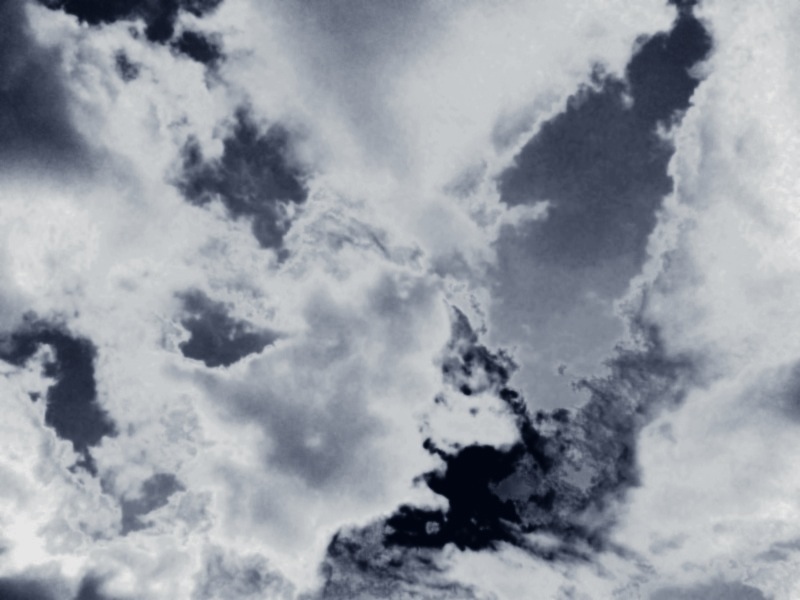
I have been taking sky portraits for over two years now. It developed out of an eerie experience I had once while on the train to work.

I suddenly AWOKE. I suddenly found myself on the train, surrounded by others on their morning routes. I had no memory of rising out of bed, my morning toilet, dressing, leaving my home, or waiting for the train. It terrified me. What had become of all my lost time? And where was I in those spans? Who was I now without that person of those times lost? I felt intermittent. Was this dangerous? Perhaps so. It troubled me.

I realized I needed a mindful practice. Something to sweep me out of the default zero-grade attention that our banal daily activities lull us into. I needed something I could do regularly no matter where I was. And so my eyes turned skyward.

As a child I used to love cloud watching. I have a distinct, visceral body memory of me laying in the grass out front of the house where I grew up. I recall the dry crackle the grass made in my ears, the slight cool dampness of it pressed into my back. The way the clouds tumbled their way across the sky, eating each other.

When I was living in Pittsburgh, I was agog at how close the sky felt. It hung just over me. Perilous.

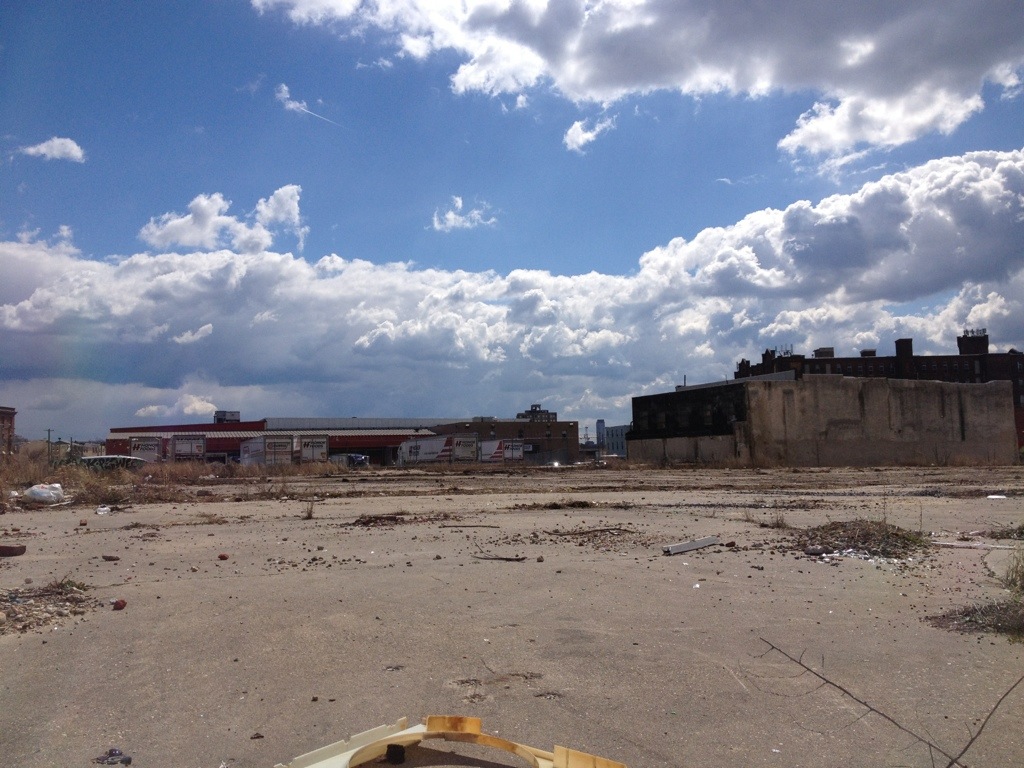
Back here in Philadelphia, it feels tamed by the lurking wild abandonment of so many of the streets near where I live.

I’m struck by a certain mode of day. I’m struck by the preciousness of that constantly evasive terrain–sky so fleet and stern. I want to say it.

20130327-225024.jpg

ImageI traveled to Naropa University early last week to participate in this discussion with Craig Santos Perez, Kass Fleisher, and Juliana Spahr on territory. I was thrilled by the invitation back in the winter, since territory is one of the primary things I think through in a broad vein of my work. How is a space overwritten and transformed for us by the various, contentious, and overlapping histories and interests that render it visible to us? How do we participate in and move through these terrains?

The first night was the panel discussion, at which the four of us gave statements. I presented first on my relationship to KOREA as a diasporic subject. Juliana detailed the spaces she has written from/about/to across her body of work and some of her thoughts about her authorial decisions. Craig offered a rich historical framework for thinking about incorporation and the organization of spaces from a federal standpoint. Kass presented a spatialized framework for how different regions of the brain house and communicate trauma.

The second day, we each held workshops. I was very interested to see our various teaching styles at work. Our workshops were only 45 minutes long. I had struggled in my preparations for this workshop…it seemed short for me to get into a solid writing exercise, and I didn’t want to lecture. Without any shared texts or contexts for discussion, I worried that a dialogue might be too shallowly construed. I ended up deciding to treat this like an opening foray, an introduction to a type of writing practice.

I had asked my genius friend Sha LaBare if I could develop something from the ecography writing practice he designed, and he was incredibly kind and sent me some helpful materials that I pared down for the workshop attendees. I designed a parallel writing mode for the class, a terragraphy, which I introduced. My second book, Underground National, is a terragraphy (in hindsight).

During the evening, we each read. I was originally slated to read second, but there was a last moment switch, and so I opened the evening again.

I was introduced by one of the most generous statements by Angel Dominguez, a former UC Santa Cruz student now at Naropa. I remembered him from when I was in Santa Cruz a year ago. I have my eyes on him.

I felt stifled by the podium. I wanted to look into everyone’s eyes, but a spotlight made me feel as though I were speaking to a warm ocean churning softly in the distance. Am I alone? I felt my attention strive to reach out across the full span of the space, how it constantly collapsed back into my own body, the warm bright honey light on my eyelashes.

Kass read next. She shared from some notes. It was a free-style monologue describing in some detail a traumatic event that happened to her. She was agitated, upset. I mirrored these sentiments. I felt anxious, nervous, alarmed by her presentation. She was in a state of peril. She kept speaking. Several people left. I didn’t understand what had happened to us all. It was messy. The room was filled with an electric charge afterwards.

Bhanu rose with lightning eyes. They mirrored the alarm of what had just happened, streamed it back into a course of events.

Juliana read after a short break. She described her participation in several occupy actions in the Bay Area–actions that she brought her child to. Her work constantly reflected back upon her actions, narrated them with a flat-lined factuality.

Craig closed the evening with three pieces, two of which will appear in his forthcoming book. He drank a full glass of water. He was charming, he ventriloquized history, he cracked jokes. He glowed with good health. He described spam, it’s colonial and military arcs.

I learned a lot from my visit. I learned that I do not fare well in dry environments. I had a troubling dream my first night there. A friend was dying after having elected to transform their body’s interior into honeycomb. Everyone kept telling me it was too difficult to save them. There was nothing to be done. I felt without hope and small, crying before my friend’s seeping body.

I haven’t been able to sleep the night through since I’ve been back. Something is being set loose in me, maybe calving. I am restless. The other night, Rae Armanteout described restlessness as the impatience for what you don’t know will happen.

I saw how a community conversation could be infiltrated, filled up by one person’s preoccupations. I saw systems and histories break open to me but continue in their same courses. I saw myself blinded and speaking out of a body that limits my view.

What is the working title of the book? 

The book is always books, practices on and off the page, physical manifestations of thought. A reaching toward.

My current books-in-process include:

Ah.Me.RICH.AH: Your Exchange Value, a translation of Amé.RICA. Tu valor de cambio by Uruguayan poet Virginia Lucas (to be published by Litmus Press).

Dolores Dorantes, A Bilingual Version of Books One Through Four of Dolores Dorantes by Mexican poet Dolores Dorantes (to be published by Kenning Editions). The specific titles of these books are: Poemas para niños (Poems for Kids), sexoPUROsexoVELOZ (PUREsexSWIFTsex), Septiembre (September), and Querida fábrica (Dear Factory).

Front Page News (currently out in the world in hopes of finding a publisher), one year of daily cut-up poems made from the front page of the newspaper in the place I woke each day.

Less Than One, More Than One (which I am in the midst of writing), the sequel to my 2009 book one (published by Palm Press).

Laws (to be published by Dusie Books), a sequence of (now very elderly) letters home from Mexico interspersed with horrified quatrains addressing the war in Iraq interspersed with musings on a book titled An Experiment With Time.

My most recent book is titled Shroud: A Piece of Fabric Sewn To A Piece of Paper By Way of A Map, a collaboration with Jill Magi. Jill wrote her “The Next Big Thing” piece about it.


Where did the idea come from for the book?

My books come from processes and relationships; insofar as these are made of ideas (alongside other things like inventions, curiosities, walks, meals, conversations and self-imposed limits) I suppose my books come from ideas that are in the world or ideas the world is lacking, which might be addressed by the book, though the book can never complete the idea. My books come sometimes from necessity, sometimes from will, sometimes inadvertently, and always with difficulty.


What genre does your book fall under?

My bio always begins in this way: Jen Hofer is a poet, translator, social justice interpreter, teacher, knitter, book-maker, public letter-writer, urban cyclist, and co-founder of the language justice and literary activism collaborative Antena. My books are exist in the spaces demarcated by the activities I’ve just listed, and in the spaces between them.


What actors would you choose to play the part of your characters in a movie rendition? 

The movie rendition (of any of the above) would be made by an experimental filmmaker who would have free reign to use any sorts of people, plants, animals or objects they might wish to include. There would be no actors. It’s all re-enactment.


What is the one sentence synopsis of your book? 

Catch me in an elevator and I’ll give you the elevator speech for each of my current projects.


How long did it take you to write the first draft of the manuscript? 

My books always take years – 3-10 years, usually. Life gets in the way of life, I find.


Who or what inspired you to write this book? 

For any project, book form or otherwise, I am inspired (and also somewhat paralyzed) by how many forces there are in the world that are the opposite of inspiration. Writing and the various public manifestations of that practice, including books, are not a corrective, but they can be a crucial reminder, counterpoint, dissonant harmony and instigation to think differently, be differently, and build a different world.


What else about your book might pique the reader’s interest? 

I love the word pique, but that’s about all I have to say in regard to this question.


Will your book be self-published or represented by an agency?

About her book The Story Of My Accident Is Ours, Rachel Levitsky said: “I like to think that being published by Futurepoem is self-publishing, as well.” I’d extend this idea to publishing with small autonomous presses generally—it is a form of participatory multi-self-publishing that is community-based, externalized, non-vain (in the sense of “vanity presses”) non-monetized (or not efficiently monetized), and entirely effortful, where the effort reminds us that the how of what we do matters as much as the what.


My tagged writers for next Wednesday are:

TBA!

Follow

Get every new post delivered to your Inbox.

Join 1,103 other followers